- Home
- Company
- Products
- News
- FAQs
- Blog
- Contact
Leave Your Message
Choosing a 48V 160Ah LiFePO4 battery requires more than comparing prices and advertised capacity. A typical pack uses sixteen 3.2V cells, creating a nominal 51.2V system and approximately 8.19kWh of stored energy. Usable energy will be lower after reserve limits, inverter losses, and recommended depth of discharge.
The market is expanding quickly. The International Energy Agency’s Global EV Outlook 2024 reported that global battery demand exceeded 750GWh in 2023, rising by about 40% in one year. BloombergNEF’s 2024 Battery Price Survey placed the average lithium-ion pack price at $115 per kWh, a 20% annual decline. These figures show stronger scale, but they do not prove that every battery offers equal safety, durability, or value. Capacity alone can mislead.
This guide presents seven practical checks for selecting a 48 V 160 Amp Battery Lifepo4 Lithium. Look closely at the battery management system, continuous discharge rating, cell grade, operating temperature, certifications, warranty terms, and manufacturer support. For example, a 160Ah battery may deliver 8kWh on paper, yet an undersized BMS could restrict a 5kW inverter during startup. That detail matters.
Measure twice.
Installation experience also matters. Confirm cable sizes, terminal torque, ventilation requirements, charging voltage, and communication compatibility before purchase. LiFePO4 chemistry is generally stable, but charging below freezing can damage cells without suitable protection. I have seen buyers focus on cycle-life claims while overlooking replacement access and service response. That mistake is understandable, but worth reconsidering. Reliable specifications, traceable test evidence, and realistic warranty conditions should guide the final decision.
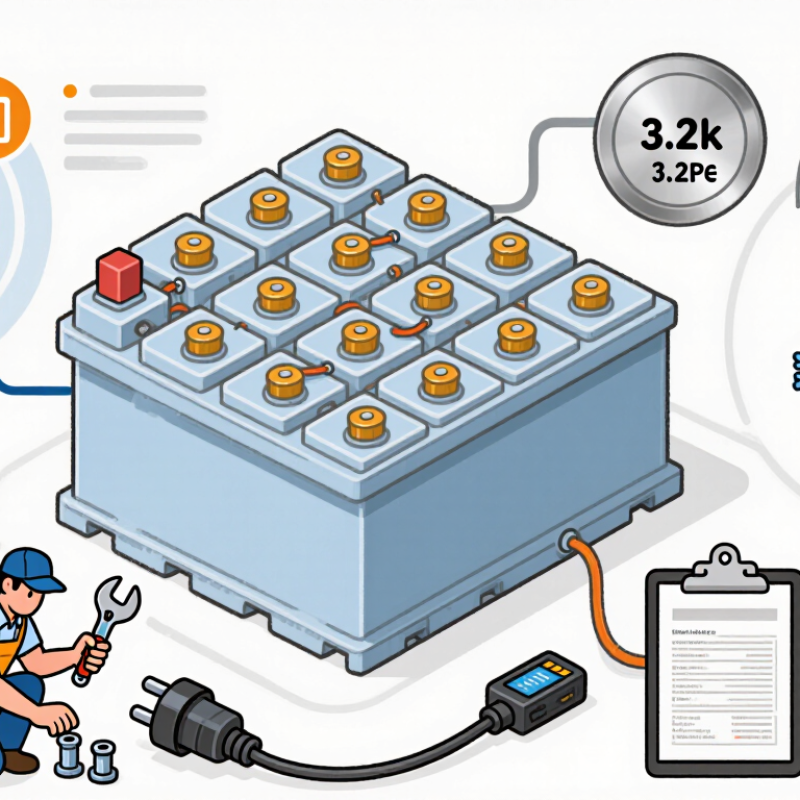
A 48V 160Ah LiFePO4 battery stores about 7.68 kWh under nominal conditions. That number is only a starting point. Your real requirement depends on load size, runtime, surge demand, and conversion losses. List every appliance, motor, light, and control device. Record its running watts and starting watts. Small loads accumulate quickly. A plug-in power meter can reveal surprising overnight consumption.
Suppose your equipment draws 1,200 watts for five hours daily. That equals 6 kWh before inverter losses. After conversion losses and reserve capacity, the battery may have little energy left. Pumps, compressors, and power tools also create short surges. Check whether the battery and inverter can handle those peaks. Continuous current matters too. At 48 volts, a 3,000-watt load needs roughly 63 amps before losses.
During sizing reviews, I have seen people trust label ratings too much. I made that mistake with standby equipment. Actual use was higher than the specification suggested. Leave room for colder temperatures, battery aging, and cloudy charging days. Do not plan to empty the battery every cycle. Check the battery’s recommended discharge limit, maximum current, and BMS response. Your load profile should guide the battery choice, not the advertised capacity alone.
Use the following practical checks to determine whether a 48V 160Ah LiFePO4 battery matches your energy demand, inverter, charging system, and installation conditions.
| Tip | Selection Dimension | What to Evaluate | Reference Data for a 48V 160Ah Battery | Recommended Action |
|---|---|---|---|---|
| 1 | Calculate Required Energy | Estimate daily energy consumption in watt-hours (Wh) by multiplying each appliance's power by its operating time. | Nominal energy = 51.2V × 160Ah = 8.19kWh. If the battery is marketed as a nominal 48V system, energy is commonly described as approximately 7.68kWh using 48V × 160Ah. Confirm the manufacturer's rated voltage before sizing. | Choose a battery with enough usable energy for the complete daily load, not just the nominal capacity. |
| 2 | Allow for Usable Capacity | Usable energy depends on the permitted depth of discharge (DoD), temperature, battery age, inverter losses, and reserve requirements. | At 80% DoD, usable battery energy is approximately 6.14kWh when calculated from 48V × 160Ah, before inverter losses. With a 90% efficient inverter, delivered AC energy may be about 5.53kWh. | Keep a reserve instead of planning to discharge the battery to 100% every day. |
| 3 | Match Continuous Load | Add the running wattage of all appliances that may operate at the same time. Compare the total with the inverter's continuous output and the battery's continuous discharge rating. | A 3,000W continuous load at 48V requires about 62.5A before conversion losses. At a lower battery voltage during discharge, the current will be higher. | Select an inverter and battery management system (BMS) with continuous ratings above the expected operating current. |
| 4 | Check Surge Requirements | Motors, pumps, compressors, refrigerators, and power tools can draw several times their running wattage during startup. | A 1,000W motor with a 3× starting demand may briefly require approximately 3,000W. The inverter and BMS must support the surge for the required duration. | Verify both inverter surge capacity and the battery's peak discharge current, including surge duration. |
| 5 | Verify Charge Compatibility | Confirm that the charger, solar charge controller, and inverter-charger use charging parameters suitable for LiFePO4 chemistry and the battery's voltage range. | A typical 16-series LiFePO4 pack has a nominal voltage of 51.2V and may use a charge voltage near 58.4V, but the exact limits vary by battery design and manufacturer. | Follow the battery data sheet for charge voltage, maximum charge current, low-temperature charging limits, and communication settings. |
| 6 | Estimate Runtime Correctly | Runtime is affected by actual load, inverter efficiency, battery voltage, temperature, and the selected DoD. | For a 1,000W AC load, using approximately 5.53kWh of delivered energy gives an estimated runtime of about 5.5 hours. Actual runtime may be shorter because of load variation and battery protection limits. | Use: Runtime ≈ usable battery energy × inverter efficiency ÷ average load. |
| 7 | Confirm Installation and Safety Needs | Review operating temperature, enclosure rating, ventilation, cable size, fuse or breaker selection, clearances, weight, and available floor or rack space. | A battery in this capacity class can store more than 7kWh of energy. Short-circuit current can be very high, so properly rated overcurrent protection and insulated connections are essential. | Install according to the battery and electrical-code requirements; use suitable protection and have high-voltage DC work performed by a qualified professional. |
Calculation note: The energy and runtime examples are estimates for sizing purposes. Actual results vary with the battery's rated voltage, usable DoD, discharge rate, temperature, inverter efficiency, wiring losses, and battery condition.